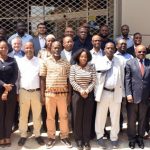
AUDA-NEPAD joined hands with UMA (Union Arab Maghreb) and COMELEC (Magreb Electricity Committee) and organised a workshop for the UMA Countries and Egypt on the introduction of competitive electricity market to the North Africa Region. This is in order to efficiently utilise the enormous energy resources available in North Africa and to enable each country to source electricity on the most competitive prices.
Most of the electricity trade in the North Africa Region is done on a bilateral basis which tie the countries involved on long term sale agreements (years ahead), and denies the countries from utilising the opportunities available in securing electricity on short terms at competitive prices.
A mission headed by Prof Mosad Elmissiry, Senior Advisor at AUDA-NEPAD, was undertaken in Algeria, 9 to 11 September 2019. It was organised with the Southern Africa Power Pool (SAPP) which is the only power pool in Africa that allows electricity trade on an auction basis on one month ahead, one week ahead, one day ahead and even hours ahead, to transfer the knowledge and experiences gained by SAPP to the North Africa Region in the development and implementation of a competitive electricity market in UMA and Egypt.
SAPP covered the stages that the development of a competitive electricity market has to go through, the requirements on hardware and software that needs to be addressed, the intergovernmental and utilities MoUs that need to be signed, the trade rules and sales clearance arrangements and the challenges faced in the introduction of the competitive electricity market. The enormous benefits gained from the introduction of the regional electricity market were highlighted.
North Africa is one the continent’s regions that have the highest electricity access rate, that exceeds 98% and is already connected with Europe, Asia and currently being connected to the Gulf States. It is the gate of Africa to the rest of the world when it comes to electricity trade.
Prof Elmissiry says that with the enormous renewable energy resources that are available in Africa, the African continent has a good chance to export the excess in clean power to Europe and earn substantial income needed for its economic development.
“Africa needs to strategise and plan ahead when oil resources are longer available,” Prof Elmissiry said. He added that with the introduction of the competitive electricity market in North Africa and the current work going ahead with regards the connection between the Eastern Power Pool and SAPP, soon almost half of the countries in Africa will be connected together. They will be able to trade electricity among themselves and beyond, on a competitive basis.
“This is a strong achievement for which Africa should take pride in,” Prof Elmissiry declared.
The engagement in Algeria ended with identifying the challenges that are facing the introduction of the electricity competitive market in the North Africa region and drafting of a road map for solutions.

Trade has been a major driver of Africa’s economic growth and receives increasing emphasis in regional and national development plans. Shippers demand high performing corridors that reduce cost and time spent on transport and logistics and increase the reliability and predictability of the corridors. Hence trade facilitation is key to continued trade growth. However, recent studies conducted by World Bank indicates that 75% of the delays in the movements of goods are from trade facilitation and that 25% is attributed to infrastructure. In this regard intra-regional trade, is often hindered by long procedures involved in passing through two sets of identical controls on each side of the border. Lengthy transit times increase the cost of trade and make African businesses less competitive. Given that Africa comprises 54 countries, 16 of which are land-locked, the negative impact of inefficient border controls on Africa’s economy is significant.

Coincide with TICAD VII, where one of the main pillars empathizes on ‘Economic Transformation and Improvement in business environment and Institutions through private investment and innovation’’ shares the same aspirations of AUDA-NEPAD to create an enabling efficient environment to facilitate trade.
To strengthen the development and operations of One Stop Border Post (OSBP), in each Regional Economic Community (REC), ‘’training of trainers (ToT) and data collection seminar for RECs’’ took place in Kigali, Rwanda from 29th to 31st July 2019. The objective of the seminar was for the REC participants to; share knowledge and experiences in the development and operations of OSBPs. The seminar was co-sponsored by African Union Development Agency (AUDA-NEPAD) and Japan International Cooperation Agency (JICA), and hosted by the East Africa Community (EAC).
REC participants were trained on the use of the African Infrastructure Database (AID) as a monitoring tool for infrastructure development in the continent. Hence in order to keep the database up to date, the delegates were requested to populate the data base with updates. This also acted as, a practical training in the use the facilities, ‘Virtual PIDA information Centre (VPIC)’ and AID.

The, Common Market for Eastern and Southern Africa (COMESA), East African Community (EAC ), Economic Community of Central African States (ECCAS), Economic Community of West African States (ECOWAS), Intergovernmental Authority on Development (IGAD), Union Economique et Monetaire de l’ouest Africaine (UEMOA) and Union du Maghreb Arabe (UMA) were each represented by three experts in the areas of ; infrastructure, customs, and immigration.
Participants had a good perception of the training in general. Most of them were pleased to have been involved, and made the following recommendations;
OSBP procedure manual developed by EAC to be shared amongst the RECs as a model in the process of rolling out the OSBP, cross pollination of knowledge and ideas through benchmarking, pre and post construction monitoring of the OSBP should be part a continuous process in the development and operation of OSBPs, Member states to ensure sustainable supply of utilities such as water, energy to the OBSP to reduce downtime, and AUDA-NEPAD to develop a model designs for OSBP as a continental blueprint.
OSBP plays a critical role in trade facilitation and regional integration. It goes without saying that ToT for RECs, which directly involved in raising awareness for OSBP development in each region, is the most efficient way of disseminating knowledge and sharing experiences. Instead of learning from another part of the world, this seminar reminded us of the knowledge and expertise that the continent has, where each region of the continent can learn from each other. ‘Africa has it all!’

To effectively support implementation of the Programme for Infrastructure Development in Africa Priority Action Plan (PIDA-PAP), AUDA-NEPAD relies on data generated by project owners, African Union member countries and Regional Economic Communities to monitor progress. Although work has been ongoing to improve the flow of information on regional and continental PIDA projects, challenges remain, in terms of data collection, verification and analysis.
In order to enhance the process and quality of data collection, AUDA-NEPAD has made two information systems available to African institutions dealing with infrastructure development – the African Infrastructure Database (AID) and the Virtual PIDA Information Centre (VPic).

AID is an online data management tool for capturing, validating and storing infrastructure projects information in Africa using standard metadata descriptors such as project characteristics, location, economic indicators, financial parameters, implementation status, et cetera. It allows Regional Economic Communities, specialised institutions, project owners and implementing agencies, to manage their infrastructure information using a harmonised user interface and clearly defined workflows. The tool also provides other information systems selected from infrastructure information, belonging to specific regions or institutions, or of certain nature, for presentation to targeted audiences.
VPic is a web-based knowledge portal focused on PIDA regional and continental infrastructure projects. Its purpose is to facilitate the sharing of PIDA-PAP information, promote participation in PIDA implementation, enable the tracking of progress in PIDA-PAP implementation (Monitoring & Evaluation), and to promote investment opportunities in PIDA-PAP projects. VPic presents validated PIDA project information stored in the African Infrastructure Database in an interactive dashboard to track project implementation.
Deployment of the AUDA-NEPAD tools for infrastructure
Since its launch in 2013, the Virtual PIDA Information Centre has been put to use by stakeholders all over the continent and beyond, as it presents up to date information on all of Africa’s 51 cross-border infrastructure projects. These projects comprise more than 400 actionable sub-projects across four main infrastructure sectors, namely energy, transport, transboundary water and ICT.
In order to improve the flow of information on PIDA projects, training and capacity building initiatives have been undertaken on both VPic and AID. The training methods used often take an interactive and hands-on approach where participants go through all the African Infrastructure Databaseand VPic functions. Thereafter, participants are given the opportunity to familiarise themselves with the platform and they continuously update project information relating to PIDA projects within their respective regions, and also provide recommendations on how the platform can be enhanced. To date, close to 200 stakeholders drawn from East African Community (EAC), Common Market for East and Southern Africa (COMESA), Souther Africa Development Community (SADC) and Arab Maghreb Union (UMA) have been sensitised, while more than 70 project owners have been trained to update information through theAfrican Infrastructure Databaseand VPic. In the latter half of 2019, sensitisation and training will be extended to Economic Community of Central African States (ECCAS) and Economic Community of West African States (ECOWAS).
PIDA Job Creation Toolkit
Another important tool is the PIDA Job Creation Toolkit, developed with support from the German Government through the Deutsche Gesellschaft für Internationale Zusammenarbeit (GIZ). The Toolkit is designed as an on-line platform that enables users to estimate the job creation potential of PIDA and other African infrastructure projects. It allows users to explore ways in which to capitalise on Africa’s demographic dividend and opportunities for wider regional economic development through job creation in infrastructure.
The Toolkit provides a scalable process enabling Project Owners to estimate job creation resulting from African infrastructure projects, especially the larger transboundary PIDA Projects. As part of beta testing, a training workshop was held in the second quarter of 2018 and estimates were developed for an initial set of PIDA projects. The workshop included a partners’ meeting in which recommendations on use cases and business models for the Toolkit were discussed. A soft launch of the PIDA Job Creation Toolkit was held during PIDA Week 2018 in Victoria Falls, Zimbabwe.
Following the successful completion of development and testing of the PIDA Job Creation Toolkit, the inaugural PIDA Jobs Outlook will be released in the third quarter of 2019. The Outlook will feature jobs estimates from selected projects in the PIDA portfolio. This inaugural edition will profile all Member States of the African Union with information on PIDA projects that are implemented in their countries or of which they are a direct beneficiary.
The Outlook is a tangible demonstration of the Toolkit which allows users to explore ways in which to maximise job creation from infrastructure projects. As an example, analysis of the Batoka Gorge Hydro Project shows that it has the potential to create more than 2500 direct and induced jobs annually up to completion of its construction and up to 24,000 secondary jobs annually over its 50-year lifetime.
Most recently, the Toolkit was presented to SADC stakeholders during the VPic Data Collection and Validation workshop where it generated a lot of interest, including a recommendation to feature the Toolkit during the SADC Industrialisation Week in August. Ultimately, the SADC Secretariat aims to have the Toolkit endorsed and adopted by SADC ministers responsible for infrastructure as an integral part of SADC’s infrastructure project planning processes. AUDA-NEPAD will, going forward, undertake capacity building on the Toolkit for all the Regional Economic Communities.
Users of the above tools include technical experts based at Africa’s regional levels, users from the African Union Member States, as well as project owners, specialised institutions, technical partners, policymakers, development partners, and both public and private providers of project preparation support and finance. The information gathered from VPic and the Job Creation Toolkit is disseminated through publication of the annual PIDA Report.
Through these tools and capacity development initiatives, AUDA-NEPAD is contributing to significantly changing the manner in which Africa reports, analyses and uses its data for policy and decision-making. The Agency is encouraging its stakeholders to place a premium on African ownership, leadership, verification and reporting.

Better connectivity will also be an important step to increasing the ICT sector’s contribution to Africa’s GDP, which currently stands at just 5%.
But government’s investments in ICT are lacking. Symerre Grey-Johnson, Head Regional Integration and Trade Division- AUDA-NEPAD Agency highlights how African governments can finance ICT infrastructure.
The highlights were made in an interview with The Guardian during the African Development Bank Annual Meeting under the theme Regional integration’ that were held recently in Equatorial Guinea.
Mr. Symerre Grey-Johnson, Head Regional Integration and Trade Division- AUDA-NEPAD Agency
According to Grey-Johnson in today’s fast-moving world, all infrastructure depends on information and communication technologies (ICTs). Global, national and local infrastructure is controlled, managed and optimized by ICTs, whether power networks, water supplies, transportation systems or communications networks.
Adding that Broadband ICT networks are increasingly critical as they represent the superstructure supporting all other infrastructures, industrial processes, socio-economic advancement and human development that follow.
He stated that the recent progress made in the evolution of telecommunications and ICT policies represents one of the remarkable success stories of global development in the past decade. The unrelenting increase in investment and expansion of communications, while far from complete, provides very encouraging testimony to the effectiveness of market-oriented reforms, and hence points clearly in the direction of the path ahead.
The Head further said that for the fundamental purpose of mobilizing financial capital to invest in ICT networks and services, a mix of open markets, free and fair competition, minimal restrictions, technological neutrality, and competent, effective regulation has proven itself repeatedly.
“Many of the remaining bottlenecks in national ICT objectives, could be greatly reduced or eliminated with additional doses of competition opportunity” he said
At the same time, however, the accelerated transformations of the ICT sectors of nearly every country continue to introduce new challenges for policymakers and regulators, who must cope with constantly changing technical and market conditions.
The key imperative remains to enable and encourage investment financing of ICTs for development objectives, and to ensure that the market and regulatory environment facing current and potential investors will allow maximum deployment of resources, in the most equitable and advantageous ways possible.
Through its ICT Broadband Infrastructure Programme, AUDA- NEPAD aimed to connect all African countries to one another and to the rest of the world by broadband optical fibre. To this end two cable systems, one submarine (Uhurunet) and another terrestrial (Umojanet) were built. Uhurunet, representing an investment of around $700 million was completed in 2012.
Author: ANGEL NAVURI
Source: https://ippmedia.com/en/news/african%20governments-urged-rethink-ict-prime-and-primary-sector

Since 2005, NEPAD Infrastructure Project Preparation Facility (NEPAD-IPPF) has approved 76 grants for regional infrastructure projects, crowding in investment financing of over US$ 8.7 billion, thereby directly impacting Africa’s integration and development agenda.
Symerre Grey-Johnson, Head Regional Integration and Trade Division- AUDA-NEPAD Agency made the statement during the African Development Bank Annual Meeting under the theme Regional integration’ that were held recently in Equatorial Guinea.
Symerre Grey-Johnson, Head Regional Integration and Trade Division- AUDA-NEPAD Agency
According to him NEPAD-IPPF was specifically instituted to address the lack of investment-ready infrastructure projects, one of the key constraints to economic development in Africa.
Grey-Johnson mentioned the key achievements which include North Core (Nigeria-Niger-BeninBurkina Faso) 330KV Transmission Project, Multinational Burundi-Rwanda,Benin -Togo- Ghana Electricity Interconnection Project, Kenya-Uganda Oil Pipeline Project, (and Zambia-Tanzania-Kenya Power Interconnection Project.
He further said that Africa’s integration is no longer a matter of choice. Against an international backdrop of changing political and economic priorities, Africa must plot a new course for its industrialization and economic develop, using the momentum of regional integration.
According to him for Africa, a vast continent of over 1.2 billion people, integration has considerable potential not only for promoting robust and equitable economic growth through markets, but also for reducing conflict and enhancing trade liberalisation.
Adding that Africa has a combined GDP of more than $3.4 trillion. Such a market could create huge opportunities for producers on the continent. But to make it a reality, African governments and regional economic communities should intensify efforts aimed at facilitating the free movement of goods, services, people and trade across borders.
According to reports Regional integration is often seen as less relevant for resource-rich countries, since demand for commodities typically comes from the global market rather than from regional demand. Regional integration in Africa, however, can play a vital role in diversifying economies away from dependence on the export of just a few mineral products; in delivering food and energy security; in generating jobs for the increasing number of young people; and in alleviating poverty and delivering shared prosperity. Therefore to accelerate the integration, the priority of economic integration must be balanced by those of social, cultural and political integration. Policy instruments, especially for overlapping REC member nations, need to be harmonised. Currently, weak enforcement of existing treaties and nontariff barriers continue to hinder free movement of goods, services and persons across borders.
Author: ANGEL NAVURI
Source: https://ippmedia.com/en/news/african%20governments-urged-rethink-ict-prime-and-primary-sector