“The NEPAD Agency Regional Integration, Infrastructure and Trade Programme remains crucial for the Continent as over 58 % of Agenda 2063’s First 10 years’ implementation plan is aligned to regional infrastructure and trade,” said Symerre Grey-Johnson, who was speaking on behalf of the NEPAD Agency CEO, Dr Ibrahim Mayaki.

As Head of the NEPAD Agency Regional Integration, Infrastructure and Trade Programme, Mr Grey-Johnson was addressing representatives from Regional Economic Communities, African Union Commission, UN organs, development partners and the NEPAD Agency team during the annual planning meeting of the Programme.
This annual meeting is convened to discuss priority actions to implement regional integration and infrastructure programmes for 2018 and beyond. During the meeting, various stakeholders involved in the implementation of infrastructure projects under the Regional Integration, Infrastructure and Trade Programme take stock of the progress made in the implementation of the projects, discuss work-plans for the current year and also come up with new proposals for accelerated implementation of Infrastructure development in Africa.
The participants also reflected on the Programme for Infrastructure Development in Africa Priority Action Plan (PIDA PAP), its achievements, challenges and ways in which the RECs, NEPAD Agency and the African Union Commission can work together for better results within PIDA PAP.
Setting the scene for the upcoming years, Symerre Grey-Johnson highlighted that NEPAD will focus on the advancement and strengthening of Africa’s Energy Transmission Network, and work centred around the realisation of the recently launched Single African Air Transport Market.
“Thirdly, the NEPAD Agency will work closely with development partners to advance trans-boundary water projects and improve sanitation continent wide,” he said.
Representing AfDB, Mr Mamadi Souare, saluted the NEPAD’s effort in building synergies among all stakeholders for speedy implementation of PIDA PAP.
“We are glad to see that the NEPAD Agency is effectively playing its planning and coordination role,” he said.
The European Commission also expressed their commitment in their cooperation with the NEPAD Agency, specifically through the newly designed EU External Investment Plan, a tool developed to encourage investment in EU partner countries in Africa in order to strengthen partnerships and contribute to achieve the Sustainable Development Goals.
The meeting concluded with the production of a 2018 work plan for the Regional Integration, Infrastructure and Trade Programme, regional economic communities and the AUC Department of Infrastructure and Energy. The 2018 activities will also include projects focused on the North Africa Transmission Corridor in Maghreb, the North South Corridors in Southern Africa, the East Africa Multimodal Corridor, the Dakar-Abidjan-Lagos Development Corridor, the Trans-African High Way in Central Africa as well as the Grand Inga Dam Project.

Africa is the continent of opportunity for the serious energy investor. There is ample choice for the discerning entrepreneur with vast natural energy resources ranging from coal, gas, hydro, solar, wind and geothermal. Access to electricity means access to opportunity and the chance for Africa to reach its economic potential. With an increasing number of urbanising youth and above average growth rates, Africa’s middle classes are ready to exercise their buying power. However, with almost two-thirds of the continent still in virtual darkness, opportunities have remained out of reach; millions of people simply do not have the power to enjoy the basic activities that will improve their living standards – healthcare, education, commerce and industry.

During the opening of the Energy Indaba Conference in Johannesburg, South Africa. Prof Mosad Elmissiry, NEPAD Agency’s Senior Energy Advisor, emphasised the importance of regional and continental perspectives, and how regional integration provides an effective approach for achieving Africa’s energy access target and providing resilience to climate change.
Regional integration and energy trade are not new to Africa. They date back to 1950 when a bilateral agreement was signed between the Democratic Republic of Congo and Zambia on the construction of 500 kV DC line between the two countries. Country interconnections continued to grow until 1995 when nine countries in the Southern Africa region got connected together, forming what is known the Southern African Power Pool (SAPP) – through the establishment of the first energy trade market in Africa. SAPP’s successful approach ignited other regional power pools to take shape, such as the West African Power Pool, the Eastern Africa Power Pool, the Central Africa Power Pool and the Comité Maghrebin de l’Electricité.
Africa’s power vision sets an energy access target of 80 percent for domestic users and 90 percent for industries by 2040. The continent came up with a strategy for achieving these targets based on a regional approach anchored on the Programme for Infrastructure Development in Africa (PIDA) Energy Infrastructure Programme. The programme has a detailed energy plan which extends to 2040 with short, medium and long term project implementation plans covering the whole continent.
Progress made in some of the PIDA projects with regards energy include: The Kaleta Power generation in Guinea that is now completed; Sambangalou in Senegal and Ruzizi hydroelectric Power Stations in Rwanda and the Democratic Republic of the Congo, which are in the final state of financial closure; The Zambia-Tanzania-Kenya interconnector, with the Kenya -Tanzania section now under construction, and Tanzania-Zambia section with completed feasibility and environmental assessment studies; The Batoka hydro project in Zambia and Zimbabwe have completed feasibility studies and are in the finance raising stage, and; The Inga III hydro project in the Democratic Republic of Congo is to complete the remaining complementary feasibility studies and its environmental assessment.
With regards, renewable energy, NEPAD Agency launched the Renewable Energy Access Programme in November 2017, which targets country priority renewable energy projects. A total of 33 renewable energy projects were received, some of which received assistance in 2017, for example the Gambia 6 MW project and Madagascar solar project.

Given the pan-African nature of the continental high speed rail project, a key objective of the African Integrated High Speed Railway Network is connectivity of Africa’s capital cities and mega-cities, including but not limited to, commercial hubs/economic zones, and tourist destinations, among others.
The viability and sustainability of the project will largely depend on the extent to which its development is linked to the planning, development and operation of existing and planned national and regional high speed railway networks, electrical power and ICT infrastructure facilities of the continent.

The existing conventional (‘low speed’) freight and passenger rail networks in Africa, essentially form the backbone of the continent’s railway infrastructure assets. They contribute significantly to the development and operations of Africa’s manufacturing, mining, and industrial outputs.
Cognisance of the magnitude of the investment required for the African Integrated High Speed Railway Network project, key selected routes and corridors, based on a proven business case, will be piloted for replication.
Priority areas of the African Integrated High Speed Railway Network project, with regards national readiness for infrastructure connectivity, include technical studies for rehabilitating and/or constructing the 12,000km missing links and at least 20% of the construction on the first pilot project which needs to be completed by 2023.
The overall project comprises 4 longitudinal and 6 latitudinal North-South and East-West continental railway networks respectively, to be implemented over a period of three planning phases; short term (2015- 2025), medium term (2025-2045), and long term (2045-2065) development plans of 50 years.
After a thorough process in accordance with African Union procurement standards, the evaluation team recommended eight consultancy firms to be shortlisted for the next stage of procurement of consultancy services, which will be the Request for Proposals. The firms will be invited to submit their technical and financial proposals to undertake the Detailed Scoping Study of the Africa Integrated High Speed Railway Network and Master Plan.
Following the opening of the technical proposals on 12 January 2018, a retreat will be held from 12 – 16 February 2018, in, Johannesburg, South Africa. The meeting will be convened in order to undertake a detailed review of the technical and financial proposals received from the seven engineering consulting firms (out of the eight shortlisted), that responded to the request for proposals issued in December 2017, by the NEPAD Agency’s Procurement Division.
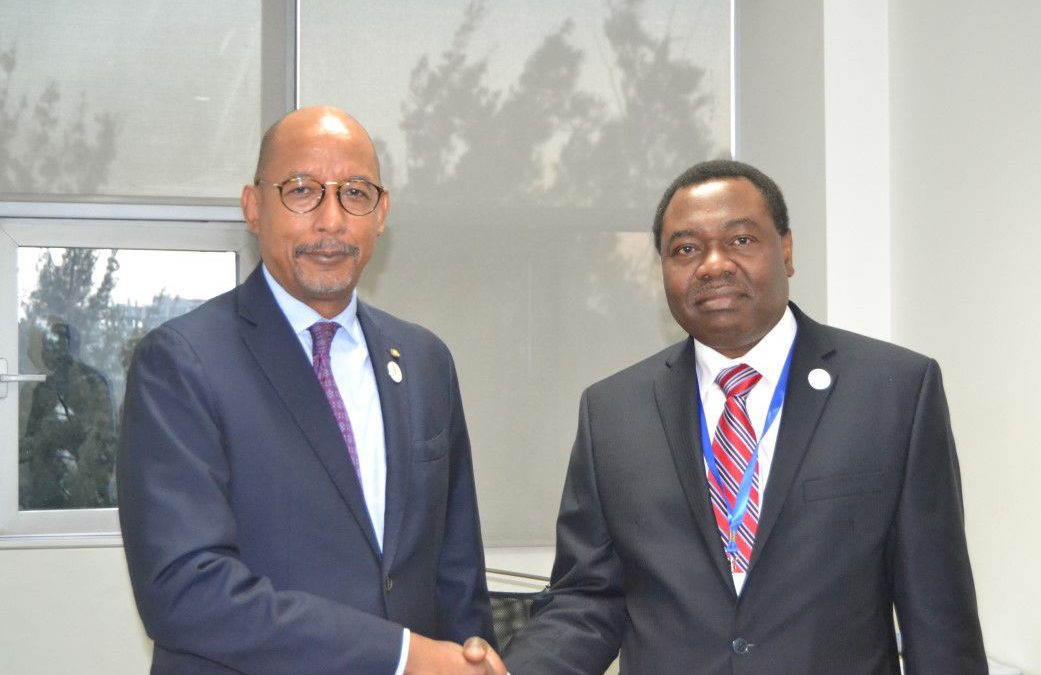
Dr Ibrahim Mayaki, CEO of the NEPAD Agency, held a meeting with the President of International Civil Aviation Organization (ICAO), Dr Olumuyiwa Benard Aliu in Addis Ababa.
The meeting was held to deliberate the design of an aviation programme under the Programme for Infrastructure Development in Africa (PIDA) that both the NEPAD Agency and ICAO could support.

Dr Ibrahim Mayaki, CEO of the NEPAD Agency with the President of ICAO, Dr Olumuyiwa Benard Aliu in Addis Ababa
During the meeting held between Dr Mayaki and Dr Aliu, the following areas were agreed upon:
- Capacity building on aviation policy, regulation and advocacy of air transport being a mass transportation medium for regional connectivity will have to be developed soonest with all relevant African institutions and ICAO.
- Discussions and a roadmap to include aviation in the design of PIDA 2020-2030 will also commence soon as agreed in the requisite action plan.
- NEPAD Agency¡¦s MoveAfrica Initiative will have to expand to strongly include aviation as part of the initiative.
- NEPAD is ready to host a Senior Officials meeting on the formulation of an action plan which will map out a concrete set of projects for consideration by ICAO and partners. This project will be centred on a Continental Aviation Master Plan and capacity building for policy makers and practitioners in the aviation sector.

A historic event at the 30th African Union Summit took place in Addis Ababa, Ethiopia, when the AU Commission launched the Single African Air Transport Market (SAATM).
The SAATM is the first AU Agenda 2063 flagship project, which aims to create a single unified air transport market in Africa, to liberalise civil aviation on the continent and to advance Africa’s economic integration agenda. (more…)