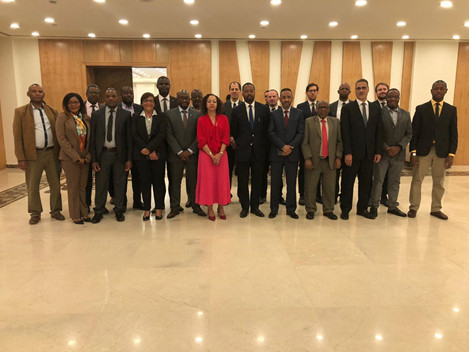
The Programme for Infrastructure Development in Africa (PIDA) Steering Committee today concluded its two-day deliberations in Cairo and set the stage for the next phase of PIDA, which will officially launch in January 2021.
The Steering Committee, as part of its bi-annual meeting, learnt from the diverse experience of experts who had formative involvement in the development of the first phase of PIDA to inform the next phase.
In his statement, the African Union Commission Director for Infrastructure and Energy, Mr. Cheikh Bedda underscored that PIDA at this time is gaining a lot of momentum and a lot of tractions from African Heads of State. He stated that all hands are on deck to bring all PIDA projects to the finish line, as the first phase of the programme is coming to end in 2020.
“We have heard from our PIDA Mid Term Review Consultants and our experts who were involved in the designing of the first phase of PIDA and this meeting was also able to thoroughly discuss the Institutional Architecture for Infrastructure Development in Africa (AIADA) and it is clear now that the stage is set to begin the development of the next phase of PIDA,” Mr. Bedda said.
“The next phase will radically be different in the way it addresses pressing needs on the continent including jobs, youth and women, low access to energy and other basic infrastructure among rural communities,” the Director added.
Echoing the same sentiments, the Head of Regional Integration Infrastructure and Trade at the African Union Development Agency (AUDA-NEPAD), Mr. Symerre Grey-Johnson, underscored the few concrete successes that were registered in support of the implementation of PIDA PAP through the various mechanism and instruments such as, the Service Delivery Mechanism (SDM), the Continental Business Network (CBN) and its NEPAD 5% Agenda, the Africa Infrastructure Guarantee Mechanism (AIGM) and the PIDA Capacity Building Programme.
Citing some of his initial suggestions for inclusion in the next phase of PIDA PAP, Mr. Grey-Johnson spoke about the critical role of a coordinated approach going forward. “I urge our partners to come on board in planning the next phase of the PIDA PAP,” Mr. Grey-Johnson noted.
Representing the African Development Bank, Mr. Mtchera Chirwa commended the partnership between the AUC, AUDA-NEPAD and AfDB under PIDA, which has achieved formidable results in advancing Africa’s infrastructure development.
Mr. Chirwa reiterated the Bank’s commitment to the development of the next phase of PIDA, which comes at a critical juncture for the future of Africa.
The Steering Committee heard presentations on the status of the implementation of PIDA PAP from Regional Economic Communities and partners, updates on the PIDA Capacity Building Project and the development of the next phase of PIDA, including a short presentation on the African Women in Infrastructure. The Steering Committee discussed the upcoming events until the closure of the current phase of PIDA PAP 1. It also served as a platform for partners to voice their ideas for the next phase of PIDA PAP.
PIDA’s governance structure the Institutional Architecture for Infrastructure Development in Africa (IAIDA) also came under strong review by the Steering Committee. The meeting also had fruitful discussions around the preparation of the 2019 PIDA Week.
The PIDA Steering Committee is the highest technical body tasked with fostering overall coordination of implementation efforts by various stakeholders and to provide general policy guidance and facilitation for smooth implementation PIDA.
Held ahead of the second ordinary session of the African Union Specialized Technical Committee meeting on Transport, Transcontinental and Interregional Infrastructure, Energy and Tourism (STC-TTIIET), the two-day meeting was jointly organized by the African Union Commission (AUC) and the AUDA-NEPAD, was co-chaired by the African Development Bank (AfDB) and supported by GIZ.
About 40 delegates representing the AUC, AUDA-NEPAD, the AfDB, UNECA, the European Union, GIZ, five Regional Economic Communities, Chinese Mission to the AU and IRENA were in attendance.

In keeping with its policy to take the electric power to the remote areas of Africa, AUDA- NEPAD sent a mission comprising Prof Mosad Elmissiry, Senior Energy Advisor to the CEO and Prof Diran Makinde, Science and Technology Advisor to Ghana.
The purpose of the mission was to undertake both technical and financial appraisals of the micro-grid projects for two of the lake Volta islands, namely Okplama and Lala.
These islands are in the Sene District of Bono East Region about 450km north east of Accra. In addition to assessing the procurement process of the Ministry of Energy, the team visited the sites chosen for the installation of the micro grid solar system and established their communities’ involvement and participation in the projects.
It took about eight hours for the AUDA-NEPAD team to travel by road and ferry to reach the islands from Accra. On Okplama Island, there is a community of 1150 people that is mainly involved in fish processing, while on Lala Island there are five communities with 2811 people, also involved in fish processing as well as pig breeding.
There are no clinics or water purification facilities on the two islands .The communities are desperately awaiting the arrival of electricity to get involved in extra commercial activities.
The micro-grid project capacity for Okplama Island is 76KW and uses solar power to generate electricity with a low voltage distribution system, while on Lala Island it is of a total of 400kW for the five communities and also uses central solar power generation station, but with 11 kV transmission systems and five transformers, and low voltage distribution network at the load sites.
Inspection of the solar station sites for both islands showed that the choice of the sites is good. The sites are central to the load centres and they have flat grounds, which require minimum effort to clear and prepare for the installation of the station.
Community involvement and participation was also found to be quite strong.
“It has been established that the provision of electricity to both Okplama and Lala islands will have significant impact on community involvement,” Prof Elmissiry concluded.
In December 2018, AUDA–NEPAD engaged the services of a consultant for Africa’s Integrated High Speed Railway Network Project. The first experts’ meeting to review the outputs of consultancy was held from the 10 -12 April 2019. The objective of the experts meeting was to review and agree to on the results and outcomes of the Project Preparation Framework analysis, to be piloted during the first 10-Year Implementation Plan of Agenda 2063.

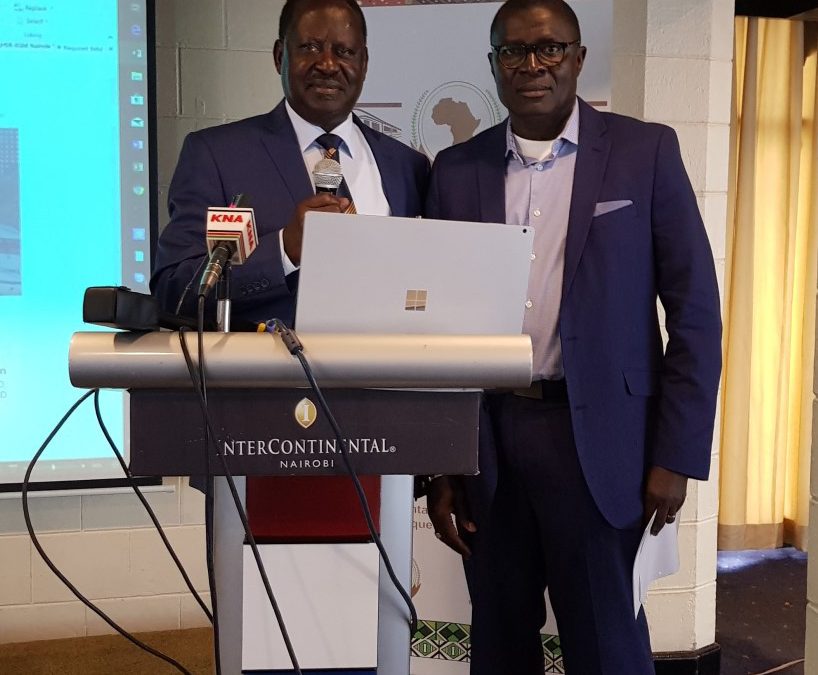
Hon. Raila Odinga – High Representative for Infrastructure Development in Africa with Mr Adama Deen , AUDA-NEPAD Senior Advisor on Strategic Infrastructure
Mr Adama Deen, AUDA-NEPAD Senior Advisor on Strategic Infrastructure stressed that the Africa Integrated High Speed Railway Network one of the flagship projects of Agenda 2063, the blue print for continental development.
Following the engagement of the consultant for the project, the inception report and the prioritisation framework have since been developed. Therefore, it is at this meeting that experts interrogated the prioritisation framework and the multi criteria analysis to be used.
“We must invest in infrastructure but do so diligently and ensure there is value for money in every infrastructure investment we undertake,’’ Hon Raila Odinga, African Union’s High Representative for Infrastructure Development in Africa informed the meeting participants.
Hon Odinga gave a presentation on what railways can do to the growth of countries and economies. He gave an example of the Kenya-Uganda railway, which cost £5m and was described as the Lunar Express. This railway was a major success to the economies of Kenya and Uganda, illustrating that in Africa, social and economic transformation cannot be attained without the development of railways.
Hon Odinga called on African leaders to make the hard decisions to develop and build its High Speed Rail for the benefit of the African people.
Mr Louis Napo Gnagbe, Project Advisor at AUDA-NEPAD welcomed all the initiatives related to promoting this major continental project.For intraregional trade to take place, Africa needs infrastructure such as railways to connect countries, projects such as the Trans-African beltway will open up the interior.
The meeting was attended by over 20 experts from around the continent. Its outcomes will be submitted to the forthcoming AU Specialised Technical Committee on Transcontinental Transport Infrastructure connectivity Experts Meeting and Ministerial Conference, slated between 14 and 18 April 2019 in Cairo, Egypt, for endorsement and adoption.
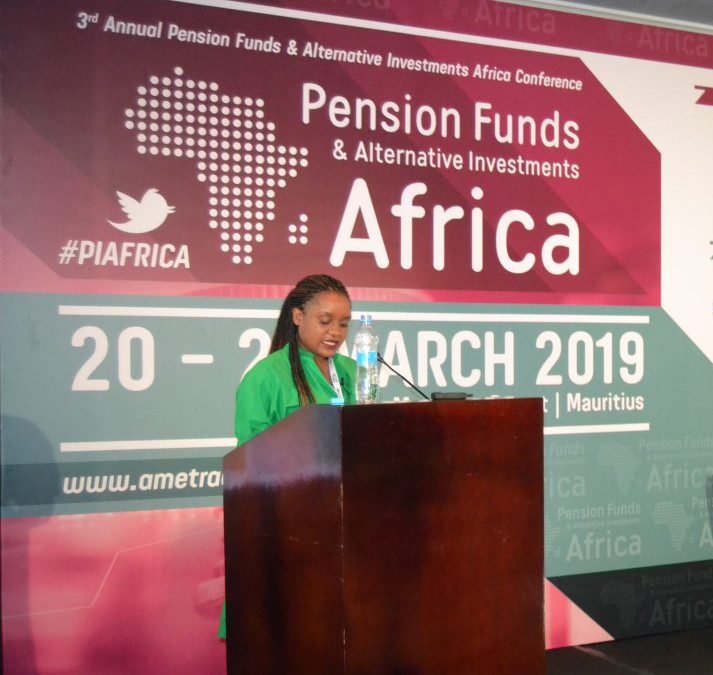
Both on and off the continent itself, Africa’s infrastructure gaps are seen as a huge investment opportunity. The AUDA-NEPAD session on ‘Scaling Risk Mitigation to enable Greater Pension Fund Investment in Africa’s Infrastructure: The African Infrastructure Guarantee Mechanism’ was organised as part of the 3rd African Pension Funds and Alternatives Investment Conference.
It was well attended by an audience mostly composed of industry players – private pension fund administrators, trustees, asset managers, government pension funds and development finance institutions. This grouping clearly demonstrates the interest to develop such initiatives to scale up greater investments in the African infrastructure space.
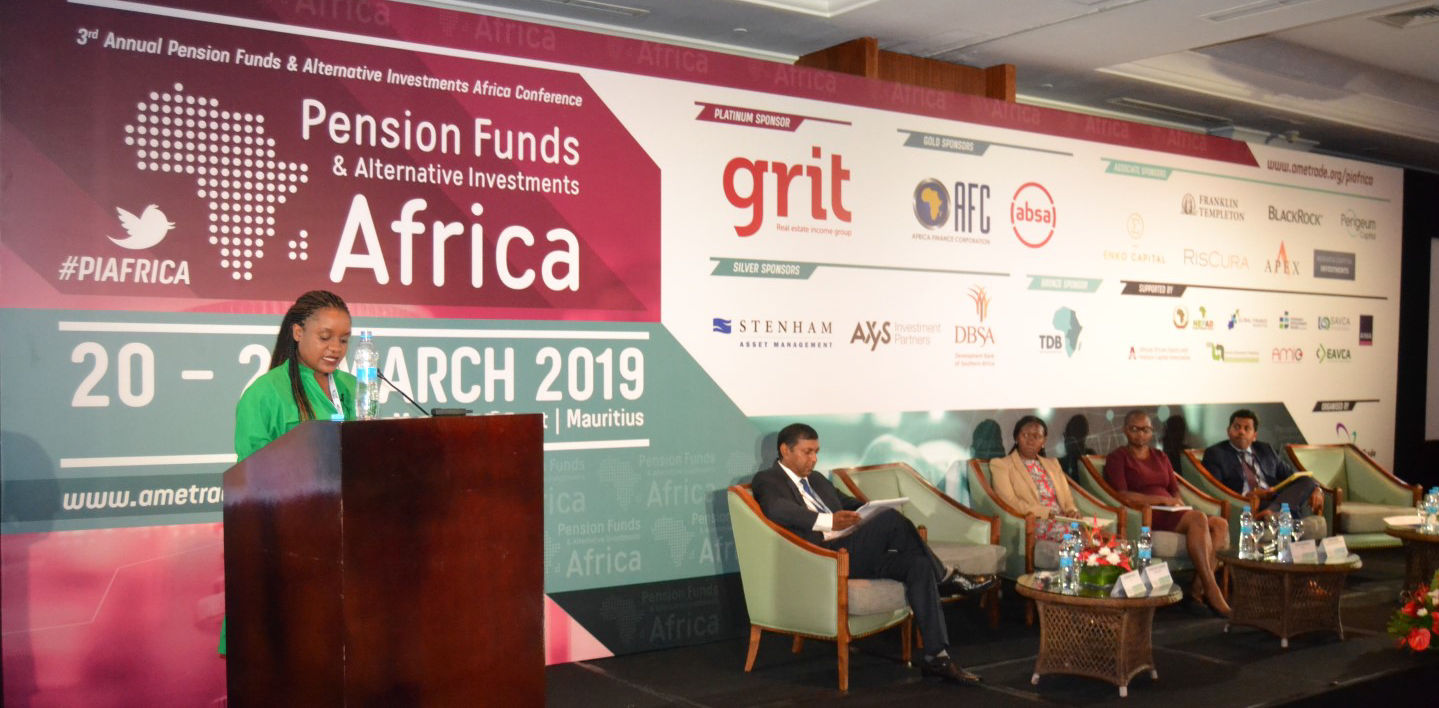
Ms Daphine Muzawazi, AUDA-NEPAD’s Monitoring and Evaluation Officer for the Regional Integration and Trade Division speaking on the African Infrastructure Guarantee Mechanism
The session was moderated by Dr Morgan Pillay Senior Infrastructure Finance Expert from GIZ, who presented the objectives of the AUDA-NEPAD session. To objectives were; to gauge the appetite of institutional investors (pension funds) for the implementation of the African Infrastructure Guarantee Mechanism and discuss its financial potential; and to make use of the Pension Fund conference platform to consult on what can make the concept a reality. This includes possible implementation strategies and concrete action steps towards scaling risk mitigation and an African Guarantee Scheme to enable the mobilisation of African pension fund investment for African infrastructure.
The session panel, with representatives from the AUDA-NEPAD, the African Development Bank; the Development Bank of Southern Africa and the Trade and Development Bank gave its interpretation of the African Infrastructure Guarantee Mechanism as instrument of risk mitigation. Industry players were requested to give their thoughts on how the development of such initiative could bring value in facilitating alternative investments in the African Infrastructure space.
Deliberations included working with development partners in the development of similar initiatives such as the African Development Bank and its co-guarantee platform with an emphasis on the infrastructure window for which component the African Infrastructure Guarantee Mechanism strategy could be leading the mechanism. Maintaining dialogue with the pension funds on what type of transactions that can be structured using this mechanism was also highlighted as key.
A strong recommendation to have a comprehensive early stage guarantee that could cover development and construction risk was also made, as well as the need to understand what the challenges are, and strengthen existing mechanisms through African Union continental coverage. The need to work on building countries’ own institutional investors that are best suited to take up currency risks as opposed to relying solely on foreign investors was also brought to the fore.
Participants were also informed of the AUDA-NEPAD Institutional Investors Forum that will be taking place in Dakar, Senegal, later this year, at which a roadmap on implementing the concept will be tabled.

“Africa: The continent of the digital future for rail” was the theme of the first African Digital Rail Summit, organised in Cape Town, South Africa, from 25 to 27 February, convened by AUDA-NEPAD and the International Union of Railways (IUC).
The initiative is part of the African Union’s Agenda 2063, of which the African Integrated High Speed Railway Network is one of the flagship projects.
This high-level meeting summit made it possible to develop the African vision of digital rail, as part of the vision of rail in Africa by 2040, defined in 2014 in Malabo.
The continent’s 90,000 km of railway lines are mainly inherited from colonisation. This network, which is too fragmented and focused on transporting raw materials to ports, still needs to be extended and interconnected in order to accelerate Africa’s economic integration. Its modernisation involves in particular the use of new digital technologies.
In a statement sent to the summit, Dr Ibrahim Assane Mayaki, CEO of AUDA-NEPAD said, “The African Integrated High Speed Railway Network is one of the flagship projects of the African Union’s Agenda 2063. The modernisation and extension of rail networks will not be possible without new digital technologies, a key element of “intelligent” transport. These technologies will help us achieve a key pillar of our regional integration.”
Transport ministers from South Africa, Egypt, Morocco and Niger are present in Cape Town, as well as the Director of the National Railways Office of Morocco. Also present are industrialists, economists, representatives of African sub-regional organisations, the World Bank, the African Development Bank, the Economic Commission for Africa, as well as experts in digital ecosystems.
In support of digitisation, Mr Adama Deen, AUDA-NEPAD Senior Advisor on Strategic Infrastructure said, “We strongly support digitalisation in rail via its various projects and vision. This is the way to respond to the need for development of mobility for both passengers and freight on the African continent.”
A roadmap will be drawn up, major projects identified and a strategy developed for the revitalisation of the African Union of Railways.