The NEPAD Agency continues with the second round of the PIDA Executive workshop on Public Private Partnerships (PPP) in the Rwandese capital, Kigali.
The workshop, which was held from 2 to 6 July 2018, is a collaborative effort between the NEPAD Agency, the African Union Commission (AUC) and the Deutsche Gesellschaft für Internationale Zusammenarbeit (GIZ). It focused on strengthening the competences of public sector project implementers within NEPAD, AUC, RECs and specialized sectoral and national institutions to enable them to coordinate/conduct/steer effective project preparation activities with a focus on planning and preparing PPPs.
The initiative is part of the PIDA Capacity Building Programme and saw PIDA implementation technical experts across the continent being trained in areas that will accelerate the implementation of PIDA projects, encourage private sector participation in infrastructure development in Africa as well as structure projects to improve domestic resource mobilization.
The training programme, which was conducted by a specialised PPP training institute, the Institute of Public Private Partnerships (IP3) based in Washington DC, compliments the many interventions that NEPAD Agency and the AUC, with the support of their partners, have developed to address the challenges of implementing PIDA projects identified during the Dakar Financing Summit.
A total of 35 participants, coming from 17 different countries attended the workshop including representatives from the African Union Commission, the NEPAD Agency, Regional Economic Communities (RECs), member States, PIDA project teams and Deutsche Gesellschaft für Internationale Zusammenarbeit (GIZ).
The workshop is the second and the final in a two-part series, the first was held in Dakar, Senegal from 26 to 30 October 2017. With each workshop, the organizers continue to build the numbers of PIDA implementation technical experts who are trained in PPP Fundamental Strategies and Techniques, Infrastructure Project Finance/preparation and PPP Procurement Strategies (from marketing to financial closure).
Lectures and working sessions during the workshop are focused on guaranteeing that participants can return to their home countries to steer effective project preparation activities and to address the challenges of implementing PIDA projects.
The workshops have facilitated learning and insights on the strategic and practical considerations, and the critical success factors in developing and operationalizing PPP projects. Significant efforts would be required in the creation of the right institutional and operational environment that is conducive to the private sector, including the introduction of necessary policy incentives, building of state capacity to develop financially viable PPP projects, and introduction of an effective dispute resolution mechanism.

According to the AfDB’s African Economic Outlook 2018, the annual infrastructure deficit in Africa is currently estimated at $108 billion. With committed leadership, political will and private sector actively involved in infrastructure development, this gap can be closed.
It is with this approach at the core of its mandate, that the NEPAD Agency Regional Integration, Infrastructure and Trade Programme convened a two-day Strategic Dialogue on Advancing Infrastructure Development in Africa. Held in Zimbabwe’s Victoria Falls from 26-27 June 2018, the meeting brought together representatives of development finance institutions, private sector experts, Regional Economic Communities, infrastructure project authorities, and project owners.
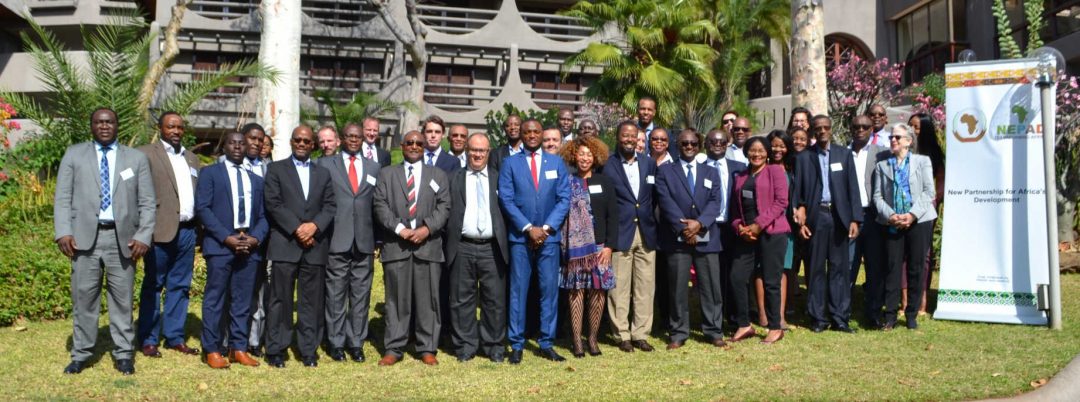
Workshop Participants
“We convened this dialogue mainly to define concrete policy recommendations for Africa’s leadership which can advance infrastructure projects implementation under the umbrella of the Programme for Infrastructure Development in Africa – PIDA,” said Symerre Grey-Johnson, Head of Regional Integration, Infrastructure and Trade Programme.
Mr Grey-Johnson who spoke on behalf of the NEPAD Agency’s CEO, Dr Ibrahim Mayaki, reiterated that the Agency deems the dia-logue as crucial in order set the scene for exploring innovative measures and instruments to close the $108 billion infrastructure gap in Africa.
In order to address this challenge, the dialogue was structured on three key areas, namely: mobilising African institutional investment through the NEPAD 5% Agenda Campaign; addressing risk mitigation and operationalising an effective African Guarantee Scheme for African infrastructure projects and enhancing the bankability of transboundary projects through the PIDA Service Delivery Mechanism.
Through the NEPAD 5% Agenda campaign, there will be an increase in investment allocations by African institutional asset owners, like Pension and Sovereign Wealth Funds, into African infrastructure from its current 1,5% of assets to a more impactful 5%.
On risk mitigation, the infrastructure experts agreed that the support given to project owners at the early stage of project preparation will aid greatly in making the projects “appealing” to potential investors. This support, along with backing from a credible African Guarantee Scheme will go a long way in securing funding for major African infrastructure projects and thereby reducing the Annual Infrastructure deficit.
The African Development Bank which has over the years provided financial support for many Infrastructure projects, was also represented at the Dialogue. Mike Salawou, AfDB Head of Infrastructure Partnerships, indicated that the Bank remains aware of the increasing Infrastructure deficit and will continue to work jointly with the NEPAD Agency to address this threat to Africa’s development.
The following proposals were made for the conceptualisation of an African Guarantee Scheme: To pool together all existing risk mitigation instruments, select only certain PIDA projects which were highly likely to be attractive to investors, through the G7 and G20, mobilise new resources into the African Guarantee Facility through the G7 and G20 process and to create a ‘Blended scheme’ which combines both sovereign guarantee and an aggregated guarantee or a combination of partial guarantees
“We [AfDB] have been at the forefront of supporting Africa and hence our strategy has been to support in the implementation of AfDB’s High 5’s Agenda, namely, “Light up and power Africa, Feed Africa, Industrialise Africa, Integrate Africa and Improve the quality of the life of the people of Africa,” he said.
The dialogue featured a robust session on the NEPAD Agency PIDA Service Delivery Mechanism and its role in providing technical support to PIDA projects throughout the project preparation cycle.
“The NEPAD Service Delivery Mechanism has been especially beneficial to the Zambezi River Authority, specifically on the Batoka Gorge Hydropower Project which is at preparation stage now. We continue to work with the SDM for technical support which will help in attracting investors to fund the project,” said Munyaradzi Munodawafa, ZRA CEO.
The Strategic Dialogue on Infrastructure has once again brought to the forefront, the premise that there is a need to make Infrastructure a tradable commodity.

NEPAD Agency participated in the Africa Rail 2018 Conference from 12-14 June. The event, dubbed Africa’s largest Rail Conference and Exhibition, brought together Railway Operators, end-users, Governments and Transport Industry stakeholders
Speaking post the conference, NEPAD Agency’s Advisor on the Continental High Speed Rail, Louis Napo Gnagbe highlighted that railway sector experts had during the conference, expressed interest in collaborating with the African Union and NEPAD Agency in the implementation of the High Speed Rail Project.
“Experts within the railway sector are excited about the work that the NEPAD Agency and AU is doing in integrating Africa through bridging the gap in spatial division between countries,” he said.
Africa Rail is an annual event, providing a meeting point for Africa’s railway sector and this year, over 28 African countries participated in the conference. The industry experts met to discuss issues on freight rail, best practices in the industry, financial engineering, regional integration, unlocking funding opportunities, infrastructure and development, as well as policy and regulation within the railway sector.
It was therefore both critical and beneficial for NEPAD Agency to participate in the event, particularly because the Regional Integration, Infrastructure and Trade Programme is responsible for the joint implementation with the African Union, of the High Speed Rail project.
The African Union and NEPAD Agency High Speed Rail project aims to connect Africa’s capital cities and megacities, including but not limited to, commercial hubs/economic zones, and tourist destinations, among others. The project is one of the 12 flagship projects of Agenda 2063 that forms the backbone of the continental strategy. It will be a facilitator for infrastructure provision on the continent, which will drive regional integration. It is based on the vision of connecting from “Cape to Cairo”.
Speaking during the conference, Dr Vera Songwe, Executive Secretary of the United Nations Economic Commission for Africa, remarked that the UNECA is committed to working jointly with the NEPAD Agency and AU towards efficient Rail transport connectivity in Africa.
Transport Ministers attended Africa Rail 2018 as well, adding to the positive and much needed political buy-in which encourages the accelerated implementation of projects aimed at developing Africa.

The International Energy Agency (IEA) and the African Union have agreed to have a strategic partnership towards a more secure, sustainable and clean energy future for countries across the African continent.
The joint commitment was formalised through a Memorandum of Understanding (MoU) signed on 28 May 2018 in Paris by Dr Fatih Birol, the IEA’s Executive Director, and H.E. Dr Amani Abou-Zeid, the African Union Commissioner for Infrastructure and Energy.
The MoU provides a general framework for cooperation on activities and projects that advance shared interests in areas of energy security, energy statistics, energy efficiency, renewable energy, and sustainable economic development.
Clean energy future for Africa
“There is a saying in Africa – if you want to go fast, you go alone; if you want to go far, you go together,” said Dr Abou-Zeid.
Dr Abou-Zeid added: “It is the reason we decided to enter into a strategic partnership with the IEA. The signing of this MoU marks a milestone for the AUC and IEA. It will strengthen our ability to deliver on our respective mandates in a mutually enriching way.”
Dr Birol also commented: “The agreement is a cornerstone of joint efforts to work toward a more secure, sustainable and clean energy future for Africa.
“The timing of our ceremony here today could not be more appropriate as across the world we celebrate this 55th anniversary of Africa Day.”
Eradicating energy poverty is a priority for the IEA and the agreement will play a vital role in stepping up efforts to achieve secure and sustainable energy for all.

Dignitaries from Africa, under the auspices of the African Union’s NEPAD Agency, in collaboration with the NEPAD/APRM Kenya Secretariat, converged on Nairobi from 23 – 24 May 2018 for the Presidential Infrastructure Champion Initiative (PICI) Technical Task Team workshop to deliberate on the way forward for the initiative and to present the progress status of each of the PICI projects. PICI is a continental initiative created to accelerate regional infrastructure development across Africa through political championing of projects.
The workshop, which was opened by Hon. Peter Munya, Cabinet Secretary, East African Community and Northern Corridor Development, brought together relevant stakeholders and the PICI Country Focal Points to provide inputs for the preparation of the Comprehensive PICI Project Status Report. The report will be submitted to the NEPAD Heads of State and Government Orientation Committee for onward transmission to the July African Union Assembly.
NEPAD Agency’s PICI Coordinator, Dr John Tambi set the scene by contextualising the PICI projects within the framework of PIDA, as a precursor to this continental strategic framework for infrastructure, before presenting to the audience the different achievements and milestones for each of the PICI projects. Dr Tambi gave the opening speech on behalf of Dr Ibrahim Mayaki, CEO of the NEPAD Agency, who stated amongst others, that the role of the Country Focal Points and members of the PICI Technical Task Team is of tremendous importance to provide leadership and direction for infrastructure development in Africa.
In attendance were development partners, from the United Nations Economic Commission for Africa (UNECA), the African Development Bank (AfDB) and representatives from the Economic Community for West African States (ECOWAS), Southern Africa Development Community (SADC), and Inter-Governmental Authority on Development (IGAD), CCTFA, and UMA. Participants were drawn from Kenya, Algeria, Egypt, Nigeria, Niger, Rwanda, South Africa and Namibia.
Progress achieved in the development of various projects under PICI across the continent was highlighted. These projects include:
- The Missing Links of the Trans-Sahara Highway and Optic Fibre Link between Algeria and Nigeria via Niger championed by President Abdelaziz Bouteflika of Algeria;
- The Nigeria-Algeria Gas Pipeline Project (Trans-Sahara Gas Pipeline) championed by President Muhammadu Buhari of Nigeria;
- The Dakar-Ndjamena-Djbouti Road/Rail Project championed by President Macky Sall;
- The North-South Corridor Road/Rail Project championed by President Cyril Rhamaphosa of South Africa;
- The Kinshasa-Brazzaville Bridge Road/Rail Project championed by President Denis Sassou Nguesso of the Congo Republic;
- The Unblocking Political Bottlenecks for ICT Broadband and Optic Fibre Projects Linking Neighbouring States and the SMART Africa Project championed by President Paul Kagame of Rwanda;
- Construction of the Navigational Line between Lake Victoria and the Mediterranean Sea championed by President Abdel Fattah el-Sisi of Egypt;
- The Lamu Port Southern Sudan and Ethiopian Transport Project (LAPSSET) championed by President Uhuru Kenyatta of Kenya; and
- The International Logistics Hub Project Championed by President Hage Geingob of Namibia.
Hon Munya informed the participants that the Lamu Port South Sudan and Ethiopian Transport (LAPSSET) project was on course and that major milestones have been achieved. The three berths being constructed by the Government of Kenya at the Lamu Port were now 48% complete. The CS further said that LAPSSET is just not for the three countries (Kenya, Ethiopia and South Sudan) but it is a continental project by all standards, as it feeds into existing transport and trade corridors such as the great North Corridor from Cape Town to Cairo (Trans-Africa Highway No:4).
In his remarks made on his behalf by NEPAD Kenya Acting CEO Mr Daniel Osiemo, Dr Julius Muia, PS State Department of Planning, reiterated the importance of cross-border infrastructure for unlocking development potential. The PS further said that PICI is playing an important role of accelerating regional infrastructure development and commended NEPAD Agency for its great work and commitment towards Africa’s integration.
Source: NEPAD Kenya