The Presidential Infrastructure Champion Initiative (PICI) was adopted to accelerate regional infrastructure development that is enabled through the political championing of projects. The role of the champions is to bring visibility, unblock bottlenecks, co-ordinate resource mobilisation and ensure project implementation. Most of the PICI projects, if not all, have made tremendous progress since its inception.
The 8th Technical Task Team workshop for the PICI was held in Windhoek, Namibia from the 23 to 24 January. The workshop was co-hosted by the Government of Namibia (Ministry of Works and Transport) and the African Union Development Agency (AUDA-NEPAD).

Namibia’s Permanent Secretary Ministry of Works and Transport, Mr Willem Goeiemann gave a description of the Namibian International Logistics Hub PICI project. Through its Transport Master Plan, Namibia aims to establish a development framework and strategies to make the country the regional logistics centre. Namibia will structure this PICI project within the context of the PICI protocol and modalities.
Representing the AUDA-NEPAD CEO, Dr Ibrahim Mayaki, Mr Symerre Grey-Johnson, NEPAD Agency’s Head of Partnerships, Regional Integration, Infrastructure and Trade said that, “PICI technical workshops not only provide a platform for knowledge sharing with all of the respective experiences, but through the active participation of all focal points, they also aim to define an implementation strategy enabling our Heads of State and Government to be actively involved in the development of these projects.”
The Champions of infrastructure in PICI include:
- H.E President Abdelaziz Bouteflika of Algeria for the Missing Link of the Trans-Sahara Highway, as well as the Optic Fibre from Algeria via Niger to Nigeria;
- H.E President Macky Sall of Senegal for the Dakar-Ndjamena- Djibouti Road/Rail;
- H.E Muhammadu Buhari, President of Nigeria for the Nigeria– Algeria Gas Pipeline: Trans-Saharan Gas Pipeline;
- H.E President Denis Sassou Nguesso of the Republic of Congo champions for the Kinshasa-Brazzaville Bridge Road/Rail;
- H.E President Paul Kagame of Rwanda champions the Unblocking of Political Bottlenecks for ICT Broadband and Fibre optic projects;
- H.E President Abdel Fattah El Sisi of Egypt champions the Establishment of a Navigational Line from Lake Victoria to the Mediterranean Sea via the River Nile Project (VICMED);
- H.E President Cyril Ramaphosa of South Africa for the North- South Corridor Road/Rail Project;
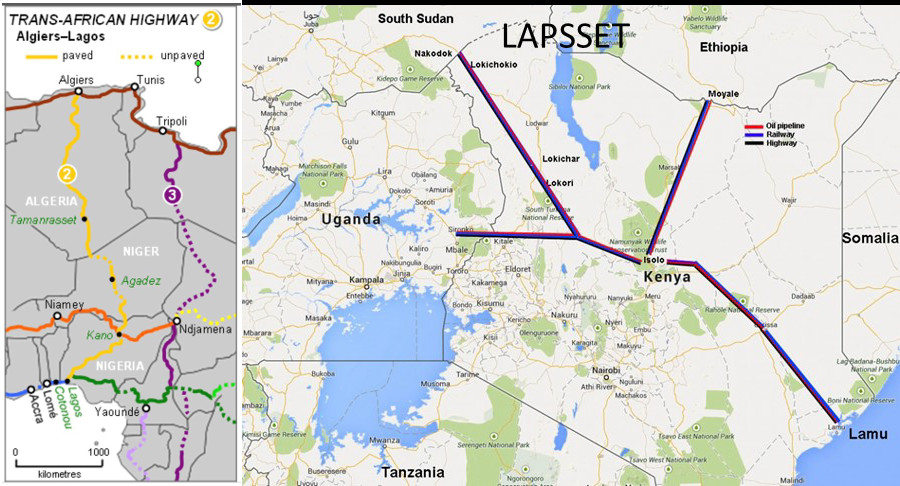
- H.E President Uhuru Kenyatta, of Kenya for the Lamu Port South Sudan Ethiopia Transport Corridor Project (LAPSSET)
- H.E President Hage Geingob, of Namibia champions the International Logistics Infrastructure Hub Projects
The Technical Task Team workshop provided a platform for effective brainstorming and round table discussions on the best and innovative solutions for infrastructure delivery for Africa ranging from infrastructure financing solutions, enabling environment, private public partnership delivery solutions based on international best practices.
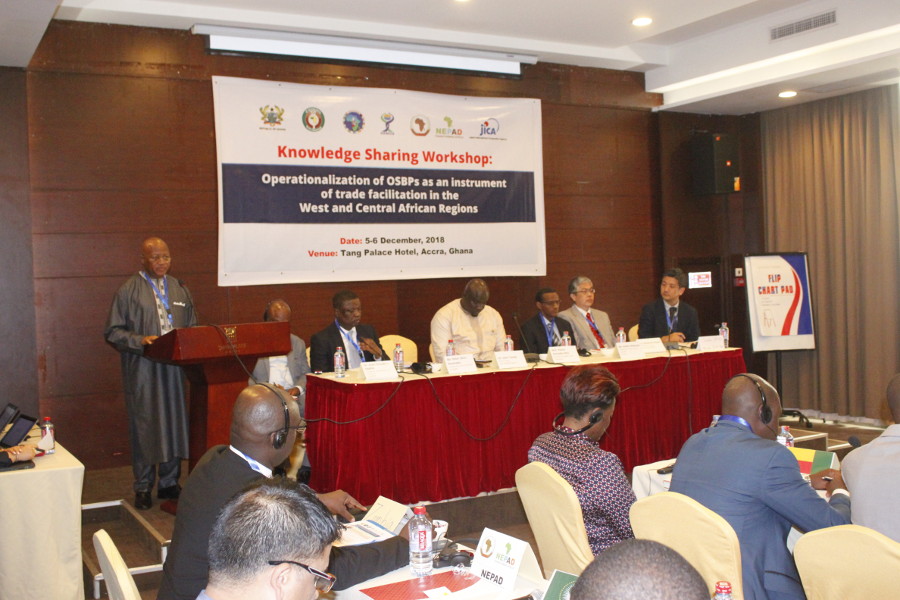
Du 5 au 6 décembre 2018, l’agence du NEPAD a organisé conjointement un «Atelier de partage des connaissances sur la manière de rendre les PCJs opérationnels en tant qu’instrument de facilitation du commerce dans les régions d’Afrique de l’Ouest et du Centre» à Accra (Ghana) avec le gouvernement du Ghana, la JICA, CEDEAO, la CEEAC et l’UEMOA. Cet atelier a spécifiquement ciblé l’Afrique de l’Ouest et du Centre.

L’Atelier avait trois principaux objectifs. Il s’agit d’abord de l’amélioration des connaissances sur la 2ème édition du guide de référence des PCJse. Ensuite, la mise à jour et le partage d’expériences de développement des PCJs dans les régions d’Afrique occidentale et centrale et le renforcement de la coopération Sud-Sud grâce aux leçons tirées des expériences de l’Est et Régions d’Afrique australe. Enfin, l’atelier visait également l’identification des défis des PCJs non opérationnels dans les régions d’Afrique occidentale et centrale ainsi que les mesures nécessaires à prendre pour les différentes parties prenantes.
En 2011, la 1ère édition du guide de référence des PCJs a été publiée pour aider les décideurs et les responsables de la mise en œuvre à développer et à opérationnaliser les PCJs. Bien que la première édition du guide de référence des PCJs se soit révélé être un outil unique et utile, il était nécessaire de mettre à jour cette référence afin que les décideurs et les responsables de la mise en œuvre puissent tirer partie des connaissances, des expériences et des bonnes pratiques actuelles. Le Consortium pour les infrastructures en Afrique (ICA), hébergé par la Banque africaine de développement et l’Agence du NEPAD, a lancé ce projet en janvier 2015 avec le soutien financier de l’Agence japonaise de coopération internationale (JICA).
La deuxième édition du guide de référence des PCJs a été publiée en mai 2016 et l’agence du NEPAD joue désormais un rôle de premier plan dans la promotion de ce manuel et soutient les CERs, les États membres et d’autres parties prenantes clés pour le développement des PCJs sur le continent. En coopération avec ses collègues des CERs, l’Agence envisage de créer un réseau de praticiens des PCJs pour apprendre les uns des autres et de mettre régulièrement à jour le guide de référence. À cet égard, les CERs sous la direction de la CUA et du NEPAD dirigent ce processus en organisant déjà des ateliers de partage des connaissances en Afrique orientale et australe. Le moment est maintenant venu pour l’Afrique occidentale et centrale.
Étant donné que les PCJs jouent un rôle important dans le développement des corridors régionaux et la facilitation des échanges, aux niveaux régional et interrégional, les participants à l’atelier ont appris des régions plus avancées en matière de développement des PCJs, dans l’esprit de la coopération Sud-Sud, ce qui correspond à une philosophie fondatrice de l’agence du NEPAD.
On 5th and 6th December 2018, the NEPAD agency co-organized “Knowledge Sharing Workshop on how to make OSBPs Operational as an instrument of trade facilitation in the West and Central African Regions” in Accra, Ghana with the Government of Ghana, JICA, ECOWAS, ECCAS and UEMOA targeted on West and Central Africa.
The aim of the workshop was:
- Improve knowledge on the 2nd edition of the OSBP Sourcebook.
- Update and share experiences of OSBP development in the West and Central Africa regions and the enhancement of South-South Cooperation through learning lessons from the East and Southern Africa regions.
- Identify challenges of nonoperational OSBPs in the West and Central Africa regions and necessary action to take for each stakeholder.
In 2011, the 1st edition of the One Stop Border Post (OSBP) Sourcebook was published to support policymakers and implementers to develop and operationalize OSBPs. While the 1st edition of the OSBP Sourcebook proved to be a unique and useful tool, there was a need to update this reference so that policymakers and implementers can learn from current knowledge, experience, and good practices. The Infrastructure Consortium for Africa (ICA), hosted by African Development Bank together with the NEPAD Agency initiated this project in January 2015 with the financial support from the Japan International Cooperation Agency (JICA).
The 2nd edition of the OSBP Sourcebook was published in May 2016 and the NEPAD agency is now taking the lead in promoting this Sourcebook and support RECs, member states and other key stakeholders for OSBP development on the continent. In cooperation with RECs colleagues, the Agency is aiming to establish an OSBP practitioner’s network to learn from each other as well as to regularly update the Sourcebook. In this regard, the RECs under the leadership of AUC and NEPAD agency are leading this process by having organized knowledge sharing workshops in East and Southern Africa already, now it is a time for West and Central Africa.
Since OSBPs play significant role in regional corridor development and trade facilitation both regionally and inter-regionally, participants of the seminar learnt from more advanced regions in terms of development of OSBPs, in the spirit of South-South Cooperation, which is corresponding to a founding philosophy of the NEPAD agency.
5c12297cdf521.php

A personal account of PIDA Week written by Millicent Kgeledi, a NEPAD Agency Communications Officer
Edited by Sandra Nyaira, UNECA Communications Officer
When I landed in Zimbabwe on Sunday, 25th November 2018, I was greeted by sweltering heat. And as we weaved through the immigration process and drove to the hotel, I complained as we chit chatted with colleagues about the unbearable heat which was way above 30 degrees Celcius.
Arriving at the hotel, the first impression was excellent. The lush green well-manicured lawns caught my eye as did the friendly staff who were on hand to give us a hearty welcome to the home of one of the great wonders of the world, the Victoria Falls or Mosi-oa-Tunya, the smoke that thunders.
As I looked around the grand Elephant Hotel buildings, a feeling began to sink in that we were set for big things in the next few days. We were indeed a few hours away from hosting a historic event in the Victoria Falls – PIDA Week 2018!! Banners were everywhere, delegates were moving around the registration area to ensure they didn’t miss the change to partake in this annual gathering of Infrastructure stakeholders from the continent and beyond. Last year PIDA Week was hosted by the Government of the Republic of Namibia. They put an excellent show and I was anxious to see what the Great Victoria Falls, through the Zimbabwe was just about to do. They definitely did not disappoint.
I quickly checked in, read through once again the concept note that we had reviewed over and over again, just to ensure that the message was clearly relayed to all and sundry and PIDA was here and set to change the face of Africa through unprecedented infrastructural development.
This annual gathering brings together key stakeholders involved in the implementation of the PIDA programme to take stock of progress and identify ways to continue to advance and accelerate implementation.
At the briefing meeting with the African Union Commission Director of Infrastructure and Energy, Mr. Cheikh Bedda and NEPAD Agency CEO, Dr. Ibrahim Mayaki, we were reminded once again to ensure that we gave our all to deliver a successful event for Africa. The overall objective being to ensure that the need for accelerated implementation of Infrastructure projects in Africa was highlighted throughout the Week. After all, when all is said and done, it should be about the radical transformation of the Continent through Infrastructure development!!
I went to bed ready to play my part…
Day 1, 26 November 2018: The Commitment is there…
We kick-stared PIDA Week with a Media Breakfast session. The room was fully packed. The enthusiasm was evident. I heard Dr. Mayaki, during his address reminding the media to advocate for transboundary infrastructure projects such as Kazungula Bridge on the border of Zimbabwe, Zambia and Botswana; to remind Africa and the world that Africa is indeed rising! He also spoke on the African Continental Free Trade Area (AfCFTA) and highlighted PIDA’s role in this initiative.
“If this African Continental Free Trade Area is well implemented, we’ll surely become a force to be reckoned with globally as we can trade among ourselves without any restrictions,” he said. His words and those spoken by others urging Africa to push transboundary life-changing infrastructure projects continued to ring in my mind as proceedings continued and I stood there to capture history in the making through my camera. My reflection didn’t last long because we had to rush to prepare for the opening ceremony…
One is always expected to multitask at these events, so I had to move from the Media Breakfast session to the Continental Business Network Roundtable session which was convened alongside the Single Africa Air Transport Market session.
As I walked into the CBN session, I was reminded of the tough but doable job lying ahead for Africa and its partners in terms of infrastructure development by the words of Symerre Grey-Johnson, Head of Regional Integration, Infrastructure and Trade Programme. He said; “To realise our goals, we need to focus on an integrated project focused approach. It is a pre-requisite to review and assess current CBN institutional and governance structures.”
From that session I moved briefly to the Single Africa Air Transport Market session. H.E Raila Odinga was attending the session!! Understandably so because the Chairperson of the African Union Commission, Moussa Faki Mahamat, appointed him as High Representative for Infrastructure Development in Africa on 20 October 2018. This decision is part of the African Union’s drive to expedite the integration of the continent through infrastructure, in order to promote economic growth and sustainable development
And then it was time for the opening ceremony, the hall was filled to capacity with about 400 delegates seated and ready to hear from their host. Zimbabwe’s National Anthem reverberated through the speakers as did the African Union one and everyone watched in anticipation as the various speakers walked onto the stage. The Zimbabwean Minister called for accelerated implementation of PIDA projects if Africa was going to deliver for its citizens.
For his part, Mr. Odinga said; “Transformational decisions have to be taken if we are to move ahead. Africa must deal with political bottlenecks that hamper its development or we shall never compete.”
I couldn’t agree with his sentiments more! I wish for an Africa which can prosper despite differing political ideologies among those in leadership positions. The unifying factor among all leaders and policy makers should be the Infrastucture for transformation!
Among those who made remarks on behalf of the various institutions and entities, were Zimbabwe’s Transport and Infrastructural Development and Transport Minister, Joel Biggie Matiza; the African Union Commissioner for Infrastructure and Energy, Dr. Amani Abou-Zeid; NEPAD Agency CEO ,Dr Ibrahim Mayaki; Infrastructure Director at the African Development Bank, Ms. Moono Mupotola: Director-General of the Belt and Road Unit, National Development and Reform Commission, the People’s Republic of China Mr. Xiao Weiming and European Commission’s Director for Planet and Prosperity, Ms. Carla Montesi.
I think all of us in that opening ceremony understood and realized one key factor: the Commitment to develop Africa’s Infrastructure is there! We just need to address the various challenges and grab the many opportunities that present themselves. And that is what the next two days of the PIDA Week was about…
Day 2: Infrastructure Experts are optimistic…
I spent the next two days attending the different sessions that focused on different aspects of PIDA implementation. I listened to Tichaona Simbini present on the Job Creation Toolkit which promises to provide a tangible indicator of jobs created through infrastructure projects. I also got a better understanding of the LAPSET project during the session also presented by Tichaona. The Traffic Light System as a catalyst for the development of One Stop Border Posts was discussed in the MoveAfrica session and of course my favourite, the much anticipated High Speed Rail, which is one of the Agenda 2063 visionary goals. In another session, I got a harsh reminder that the Abidjan-Lagos Corridor needs more investors in order to complete the project.
After this week-long memorable journey with the NEPAD Agency Regional Integration, Infrastructure and Trade Programme, I have no doubt that an integrated, prosperous Africa is not a far-fetched dream, it just needs committed stakeholders across the board – from Public to Private Sector, to Infrastructure experts and development partners. PIDA Week 2018 has surely proven that the commitment is there.
“If we want to accelerate Infrastructure Development in Africa, we need to deliver as one”, said Dr Mayaki as he officially closed PIDA Week 2018.
And I couldn’t agree with him more.

“Africa needs to unite and work hard to reverse colonial infrastructure systems which promoted the extraction of profitable agricultural and mineral wealth for export at the expense of local communities and the continent,” Zimbabwe’s Transport and Infra-structural Development and Transport Minister, Joel Biggie Matiza said as the Programme for Infrastructure Development in Africa (PIDA) Week opened on 26 November in Victoria Falls, Zimbabwe, buoyed by gathering momentum.
Speaking during the opening session of the 2018 PIDA Week in Victoria Falls, Mr Matiza said for Africa to fully develop and integrate, there was need for the continent to focus on infrastructure development, in particular transboundary projects, to ensure it was competitive enough to make a difference.
The official opening of PIDA Week in Victoria Falls town, Zimbabwe
“Historically African countries inherited underdeveloped infrastructure geared towards exports-imports transportation rather than focusing on transforming and improving local production capacity as well as promoting intra-Africa trade. This is rea-son for us to reverse this legacy and as a continent we have crafted a new trajectory through PIDA, a turning point we should follow to ensure we transform the current state of affairs,” he said.
Mr Matiza hailed PIDA for its efforts in trying to bridge Africa’s infrastructure deficit. He said PIDA Week offered a valuable opportunity for policymakers, project developers, private sector, civil society, and academia to exchange views and proffer solutions towards the implementation of regional infrastructure projects on the continent.
CEO of the NEPAD Agency, Dr Ibrahim Mayaki said Africa needs to accelerate the development of transboundary infrastructure projects if it is to fully integrate. He said a lot of progress has been made since African leaders adopted PIDA in 2012.
“We recognise that optimal solutions for continental problems lie in regional integration. We are getting there progressively, but we need to accelerate implementation if we want regional integration. It’s not a question of lack of financial resources, it is a question of lack of bankable projects and sound rules. So we need to do our homework,” said Dr Mayaki, adding that local, national and regional governance was key to the success Africa seeks in closing its infrastructure deficit.
The African Union Commissioner for Infrastructure and Energy, Dr Amani Abou-Zeid said the current low levels of infrastructure on the continent posed one of the biggest challenges to Africa’s industrialisation and development agenda, which is having a negative impact on Africa’s competitiveness and participation in the global markets.
According to the World Bank, the state of infrastructure in sub-Saharan Africa in respect of its electricity, water, roads and ICT, reduces national economic growth by 2 percent annually and reduces productivity by as much as 40 percent. The financing gap in Africa for infrastructure development is estimated at between US$130 -170 billion per year.
African Union’s High Representative for Infrastructure Development, Honorable Raila Amollo Odinga, said Africa needs to move away from the conference and feasibility study syndrome and move to implement agreed projects if it is to successfully integrate and achieve sustainable development and change the lives of its citizens for the better.
“Transformational decisions have to be taken if we are to move ahead. Africa must deal with political bottlenecks that hamper its development or we shall never compete,” said Mr Odinga. “We must also overcome the habitual of feasibility study after feasibility study without implemention. We must change.”
Ms Carla Montesi, European Commission’s Director for Planet and Prosperity and a representative of COMESA Secretary General, Ms Chileshe Kapwepwe, also spoke in the opening session in support of Africa’s desire to invest in infrastructural development that will support Africa’s growth. Ms Montesi said the EU will continue to support Africa in its quest for an integrated infrastructure that generates jobs for the youth; helps reduce poverty; and supports regional integration.
Mr Xiao Weiming, Director-General of the Belt and Road Unit, National Development and Reform Commission, the People’s Republic of China, said his country will continue to work with African nations to help build their infrastructure capacity.
The 2018 PIDA Week theme was ‘Realising Africa’s Integration through Smart Infrastructure and Good Governance’. It built on the relative achievements and the momentum created in the previous three events to continue to engage stakeholders on the effective delivery of infrastructure on the continent. The event welcomed more than 400 participants brought together through an impressive line-up of top-level government representatives, influential industry leaders, private sector, leading thinkers from international institutions, government, academia, business and finance.