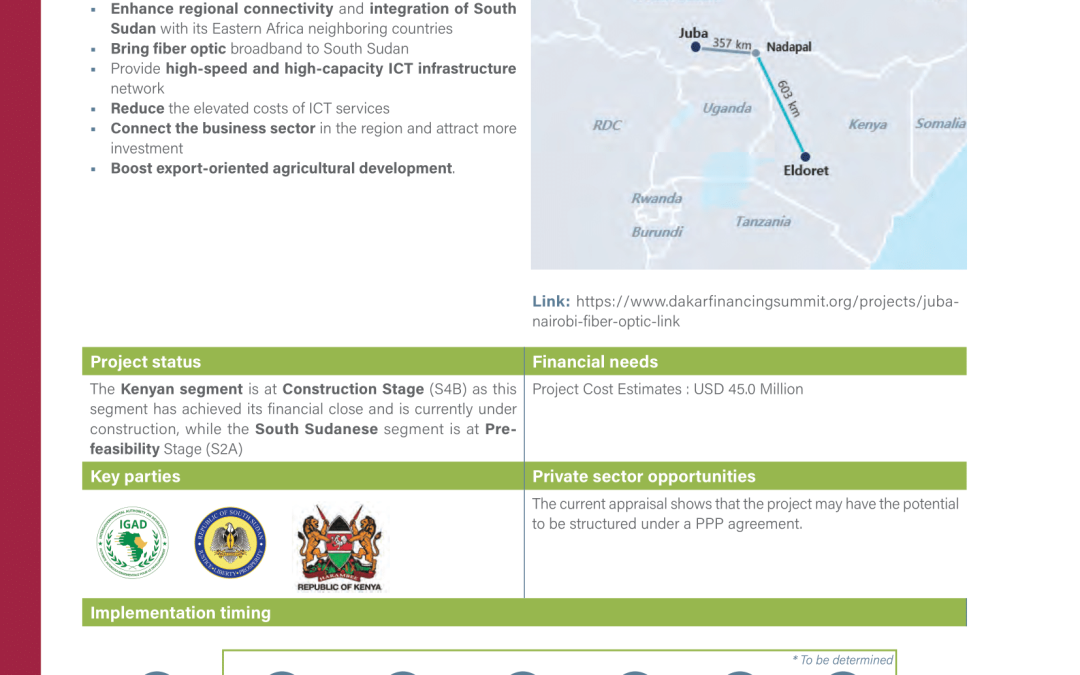
The Juba – Nairobi Fiber Optic Link Project consists of the construction of the 957 km high-capacity optic fiber cable (OFC) to interconnect Eldoret (Kenya) to Juba (South Sudan)
through the Nadapal border town.
The project objectives are to:
• Enhance regional connectivity and integration of South Sudan with its Eastern Africa neighboring countries
• Bring fiber optic broadband to South Sudan
• Provide high-speed and high-capacity ICT infrastructure network
• Reduce the elevated costs of ICT services
• Connect the business sector in the region and attract more investment
• Boost export-oriented agricultural development.
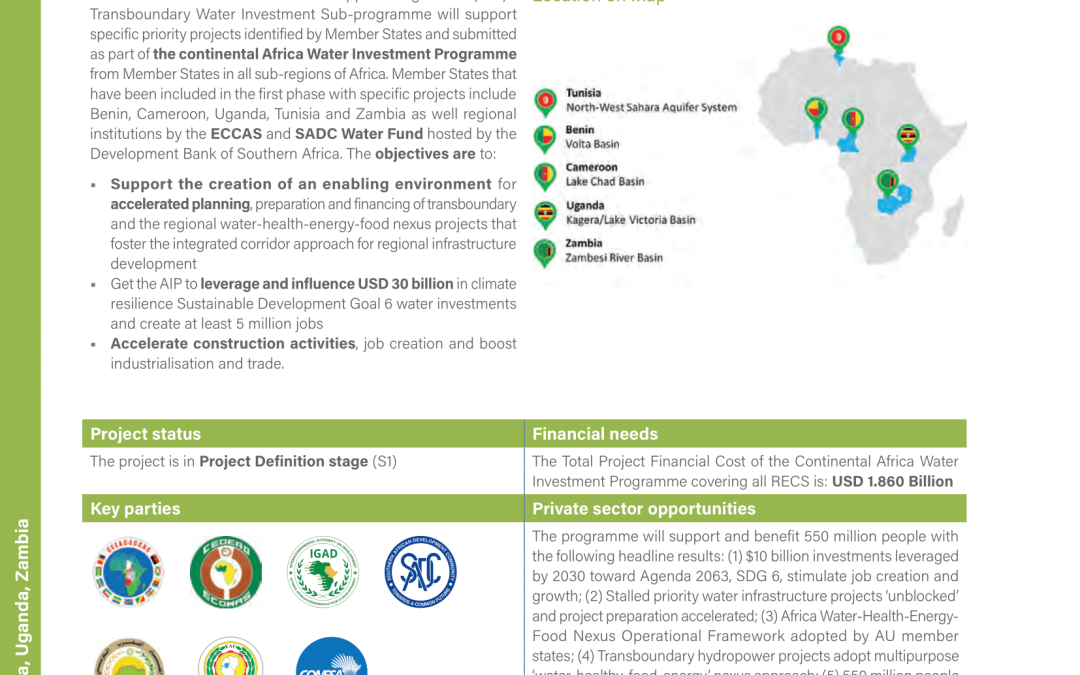
The Continental Africa Investment Support Programme (AIP)’s Transboundary Water Investment Sub-programme will support specific priority projects identified by Member States and submitted
as part of the continental Africa Water Investment Programme fromMember States in all sub-regions of Africa. Member States that have been included in the first phase with specific projects include
Benin, Cameroon, Uganda, Tunisia and Zambia as well regional institutions by the ECCAS and SADC Water Fund hosted by the Development Bank of Southern Africa. The objectives are to:
• Support the creation of an enabling environment for accelerated planning, preparation and financing of transboundary and the regional water-health-energy-food nexus projects that
foster the integrated corridor approach for regional infrastructure development
• Get the AIP to leverage and influence USD 30 billion in climate resilience Sustainable Development Goal 6 water investments and create at least 5 million jobs
• Accelerate construction activities, job creation and boost industrialisation and trade.
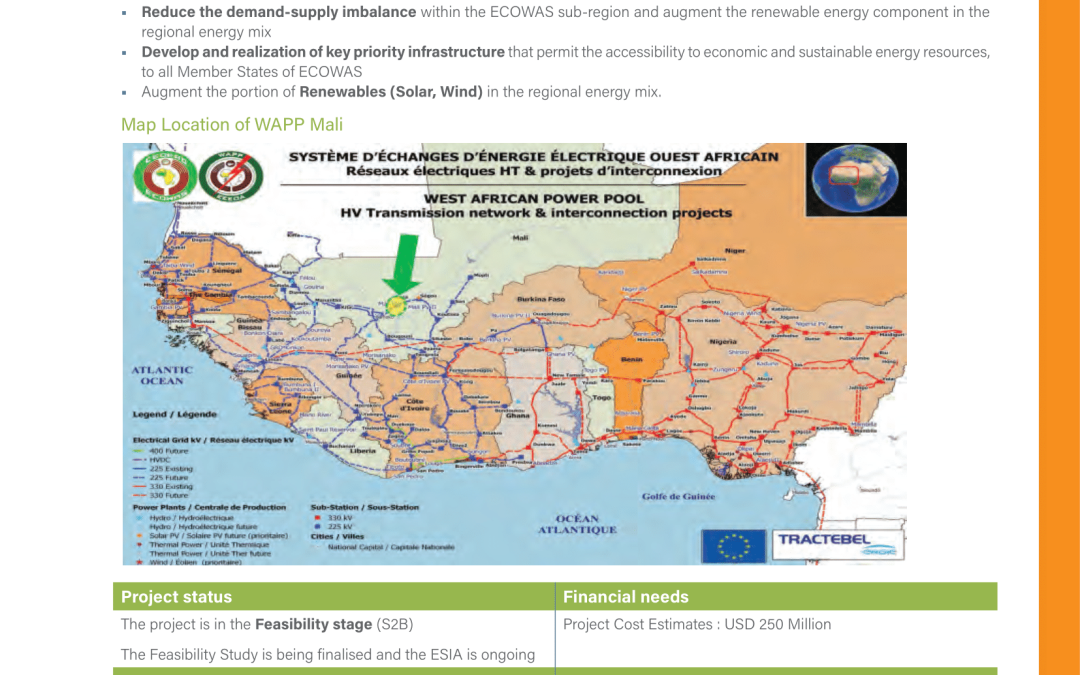
The implementation strategy of the WAPP assumes the realisation of distinct but mutually complementary infrastructure sub-programmes which, when realised, will result in an integrated efficient electricity system in West Africa. The WAPP Regional Solar Power Park Project in Mali of potential capacity 150 MW features prominently among the Priority Projects. The Project is scalable, multiphase and multisite.
Three sites are selected, namely Fana, Bougouni and Sanankoroba around Bamako. The project objectives are to:
• Reduce the demand-supply imbalance within the ECOWAS sub-region and augment the renewable energy component in the regional energy mix
• Develop and realization of key priority infrastructure that permit the accessibility to economic and sustainable energy resources, to all Member States of ECOWAS
• Augment the portion of Renewables (Solar, Wind) in the regional energy mix.
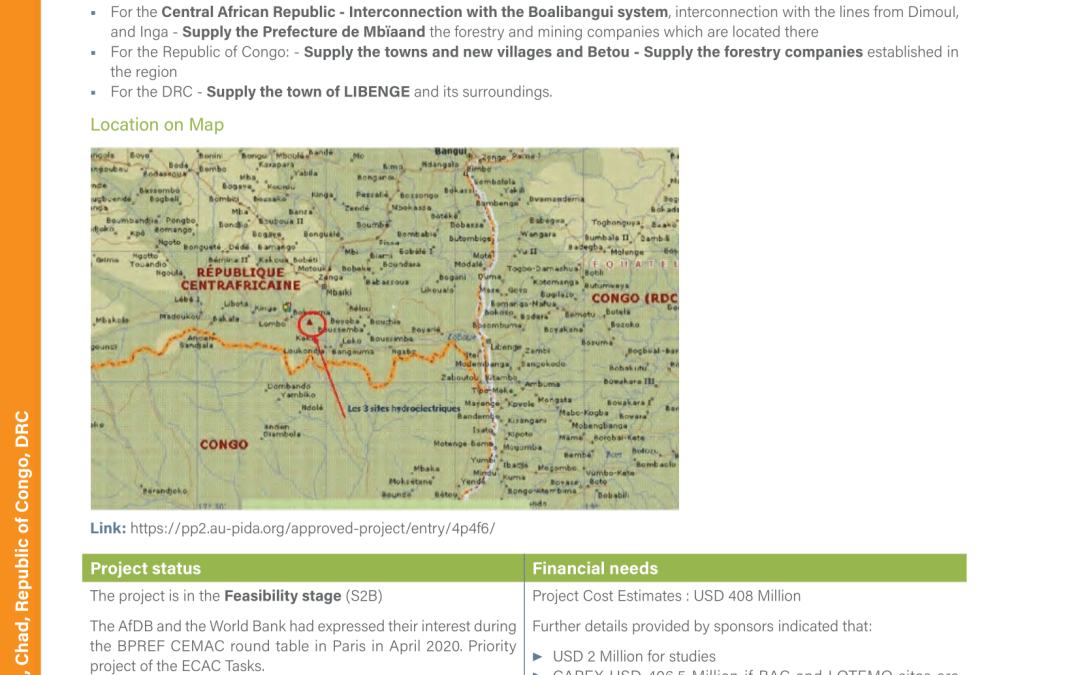
The hydroelectric development sites on the Lobaye are located in the South-West of the Central African Republic (CAR), in the locality of M’baïki, 100 km from Bangui. This location is par excellence favorable to the supply of electricity to border countries such as the Republic of Congo in its North-Eastern part, the DRC in its equatorial part (the city of Libengué and its surroundings). The Lobaye project, with an installed capacity of 60 MW. The project objectives are to:
• For the Central African Republic – Interconnection with the Boalibangui system, interconnection with the lines from DimouI, and Inga – Supply the Prefecture de Mbïaand the forestry and mining companies which are located there
• For the Republic of Congo: – Supply the towns and new villages and Betou – Supply the forestry companies established in the region
• For the DRC – Supply the town of LIBENGE and its surroundings.
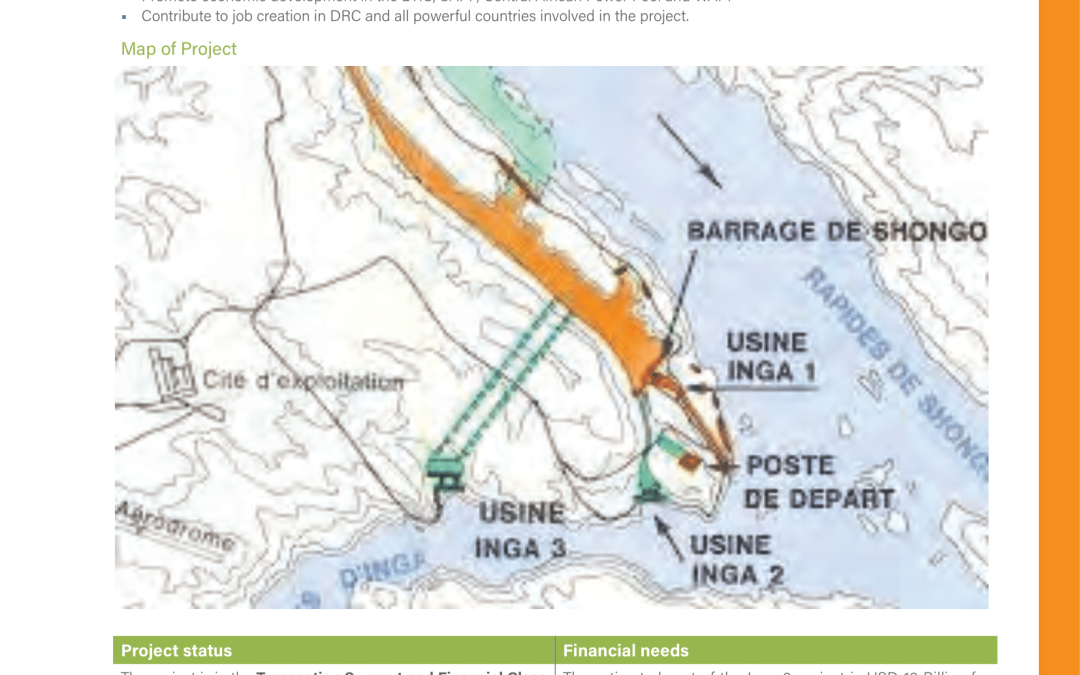
The overall objective of the project is to generate 11,050 MW at the Inga site by building a hydropower plant with transmissions lines within DRC and across borders. Transmission lines are designed to connect with South Africa through SAPP power lines. In the western part of the DRC, transmission lines could link with Nigeria and Angola. In particular the project will:
• Contribute to increased power interconnections across Africa
• Facilitate trade in power between SAPP and DRC
• Promote economic development in the DRC, SAPP, Central African Power Pool and WAPP
• Contribute to job creation in DRC and all powerful countries involved in the project.